 English
 Romana

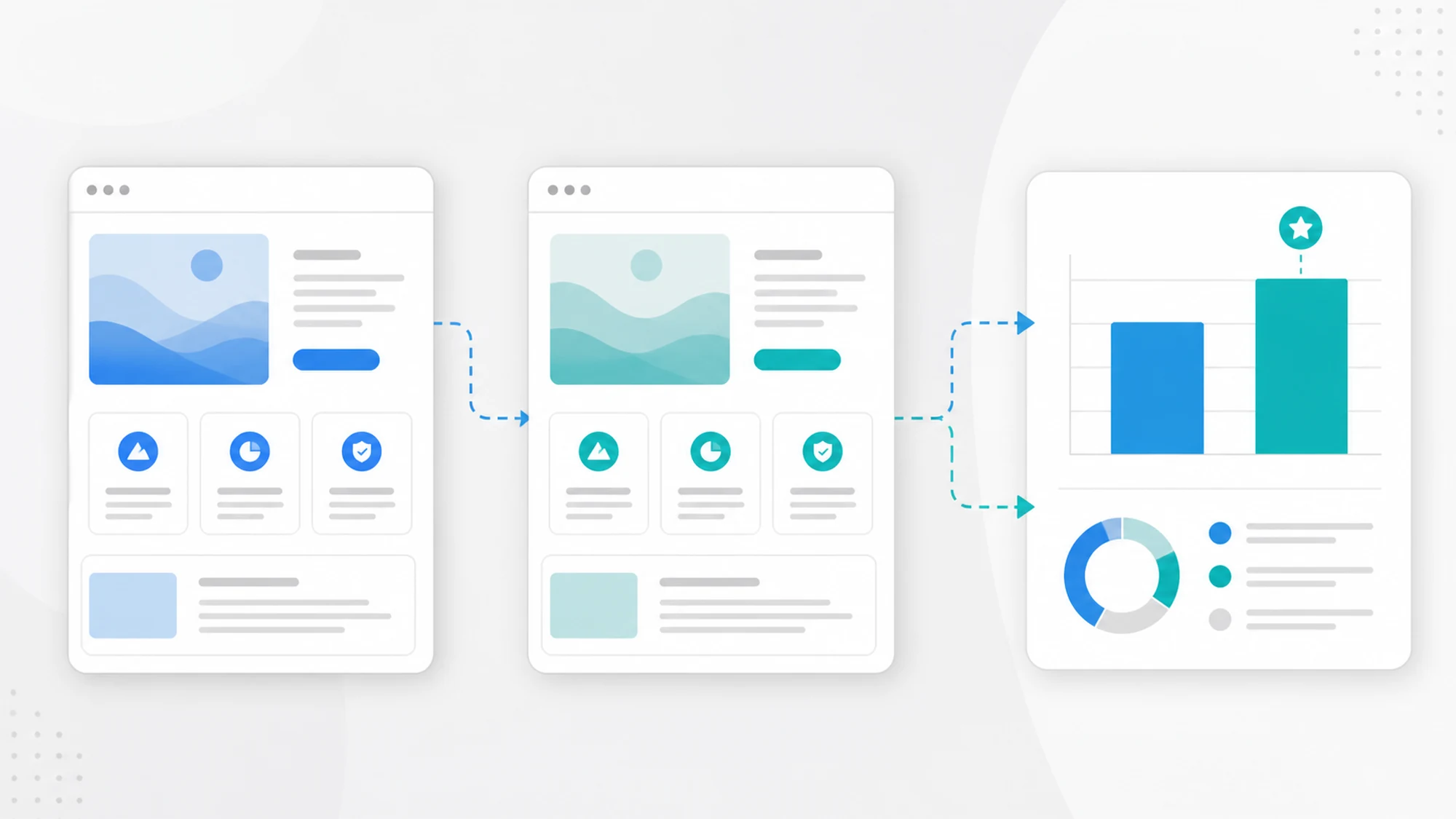
An online store changes the checkout button text from "Buy Now" to "Add to Cart" for half of its traffic, keeps the old version for the other half, and after two weeks finds the new version drives 9% more orders. That is, in essence, an A/B test: a controlled comparison between two versions, measured on real behavioral data, not assumptions.
A/B testing is the method of randomly splitting traffic to a page, an ad, or an email between two versions, then comparing their performance on a clear metric: click-through rate, conversion rate, cost per acquisition. The winning version is the one that produces the desired result by a margin large enough not to be statistical chance.
Testing is not an agency luxury — it is the only way a design or copy decision moves from "I think" to "I know." Without it, campaign budgets get optimized on intuition, and intuition is wrong often in digital marketing.
What you can test: elements with real impact
Not every element deserves its own test — some changes have negligible impact and burn traffic without producing a clear result. Elements with consistently proven impact:
- The headline of the page or ad — usually the element with the largest effect on conversion rate.
- Call-to-action (CTA) — button text, color, and position on the page.
- The main image or creative — especially in Meta Ads, where the creative drives a large share of CTR.
- Form structure — the number of required fields directly affects completion rate.
- Displayed price and offer framing — "20% off" vs. "save $10" can produce different results on the same product.
- Targeted audience — not a classic page A/B test, but it uses the same statistical logic to compare two audience segments.
How to build a correct A/B test, step by step
- Formulate a clear hypothesis: "If I change X, then Y will improve, because Z" — don't test randomly, without a theory behind it.
- Test a single element per experiment (headline, CTA, image). Testing multiple elements at once requires multivariate testing, not a simple A/B test, and needs far more traffic.
- Define the primary success metric before starting (conversion rate, CPA, CTR) — don't pick the metric after seeing the results.
- Split traffic randomly and evenly between versions, using the platform's testing tool (Google Optimize/GA4 experiments, Meta A/B Test, a CRO plugin) or your own server.
- Run the test until it reaches statistical significance and a minimum volume of conversions per version, not just a fixed number of days.
- Declare a winner only if the difference is statistically significant; otherwise the test is inconclusive and should be repeated with more traffic or a different hypothesis.
Statistical significance: why it matters and how to read it
Statistical significance shows the probability that the observed difference between versions is real, not random. The standard used in marketing is a 95% confidence level, meaning there is under a 5% chance the result is a false positive.
Orientative numeric example: version A gets 1,000 visitors and 40 conversions (4%); version B gets 1,000 visitors and 55 conversions (5.5%). The difference looks large in percentage terms, but with small conversion volumes, a significance calculator may show the result hasn't yet reached the 95% confidence threshold. The correct conclusion here is to keep running the test, not declare a premature winner.
The most common mistake is stopping a test the moment one version looks ahead, without waiting for the minimum data volume. This behavior, called peeking, artificially inflates the false-positive rate and leads to decisions based on statistical noise rather than a real signal.
How much traffic and time you need for a valid test
| Context | Orientative recommendation |
|---|---|
| Minimum conversions per version | at least 100, ideally over 300, for stable results |
| Minimum duration | at least one full week cycle, to cover day/night and weekend variation |
| Under 500 visitors/month on the page | the test can take months; consider testing high-impact elements instead of minor details |
| Seasonality or promotions | avoid drawing conclusions from a test run only during a sale period or holidays |
For low-traffic sites, a classic page A/B test can be impractical. In that case, testing at the ad level (creative testing in Meta Ads or Google Ads), where impression volume is higher, delivers results faster than a landing page conversion test.
A/B testing in Google Ads and Meta Ads: practical differences
In Google Ads, testing is usually done through multiple responsive ad variations within the same ad group, where the algorithm automatically rotates headline/description combinations and optimizes toward the best performers. For rigorously controlled tests (budget, bidding, landing page), Google offers campaign experiments, which split traffic proportionally between the original and the new version.
In Meta Ads, the A/B Test feature in Ads Manager lets you directly compare creatives, audiences, or placements, with controlled budget splitting, so results aren't skewed by one ad set competing against another for the same audience through internal auction overlap.
Common A/B testing mistakes
- Stopping the test too early, as soon as one version appears ahead, before reaching statistical significance.
- Testing multiple elements at once without a multivariate methodology — makes it impossible to attribute the result to a single change.
- Too little traffic for firm conclusions — a test with 20 conversions per version lacks sufficient statistical power.
- Ignoring seasonality — a test run only during Black Friday doesn't reflect behavior the rest of the year.
- No clear hypothesis — testing at random, without a reason why one version should perform better, makes even a significant result hard to interpret.
Tools for A/B testing
- Google Analytics 4 + Google's experimentation tools — for page tests integrated with existing traffic data.
- Meta Ads Manager — A/B Test — native testing of creatives, audiences, and placements in Meta campaigns.
- VWO, Optimizely, Convert — dedicated CRO platforms with no-code visual testing and automatic significance calculation.
- Statistical significance calculators (freely available from most CRO vendors) — useful for quickly validating a result before declaring it a winner.
Practical plan: your first A/B test in 30-60-90 days
- Days 1-30: identify the page or ad with the highest traffic volume and lowest conversion rate; formulate a single improvement hypothesis.
- Days 30-60: run the first test (headline or CTA), monitor conversion volume, and don't stop the test before the minimum threshold is reached.
- Days 60-90: implement the winning version, document the result, and start the next test on another element of the same page or ad.
Frequently Asked Questions about A/B Testing
What's the difference between A/B testing and multivariate testing?
A/B testing compares two versions of a single element. Multivariate testing compares multiple elements and their combinations at once, but requires far more traffic for conclusive results.
How long should an A/B test run?
There's no universal fixed duration; the test runs until it reaches the minimum conversion volume per version and the statistical significance threshold, covering at least one full week cycle.
Can I run A/B tests on a low-traffic site?
Yes, but results take longer to become conclusive. An alternative is testing at the ad level, where impression volume is usually higher than traffic to a single page.
What if my test comes back inconclusive?
An inconclusive test isn't a failure — it means the difference between versions isn't large enough for firm conclusions. You can keep running the test with more traffic or switch the hypothesis to an element with higher potential impact.
Conclusion: systematic testing beats intuition
A/B testing turns marketing decisions from guesses into verifiable data. The key isn't testing everything, all the time, but testing with a clear hypothesis, one element per test, and enough traffic for a statistically valid result. One test run correctly delivers more value than ten tests stopped too early.
Want to launch campaigns that deliver measurable results? Contact us for a free audit.



Write a comment